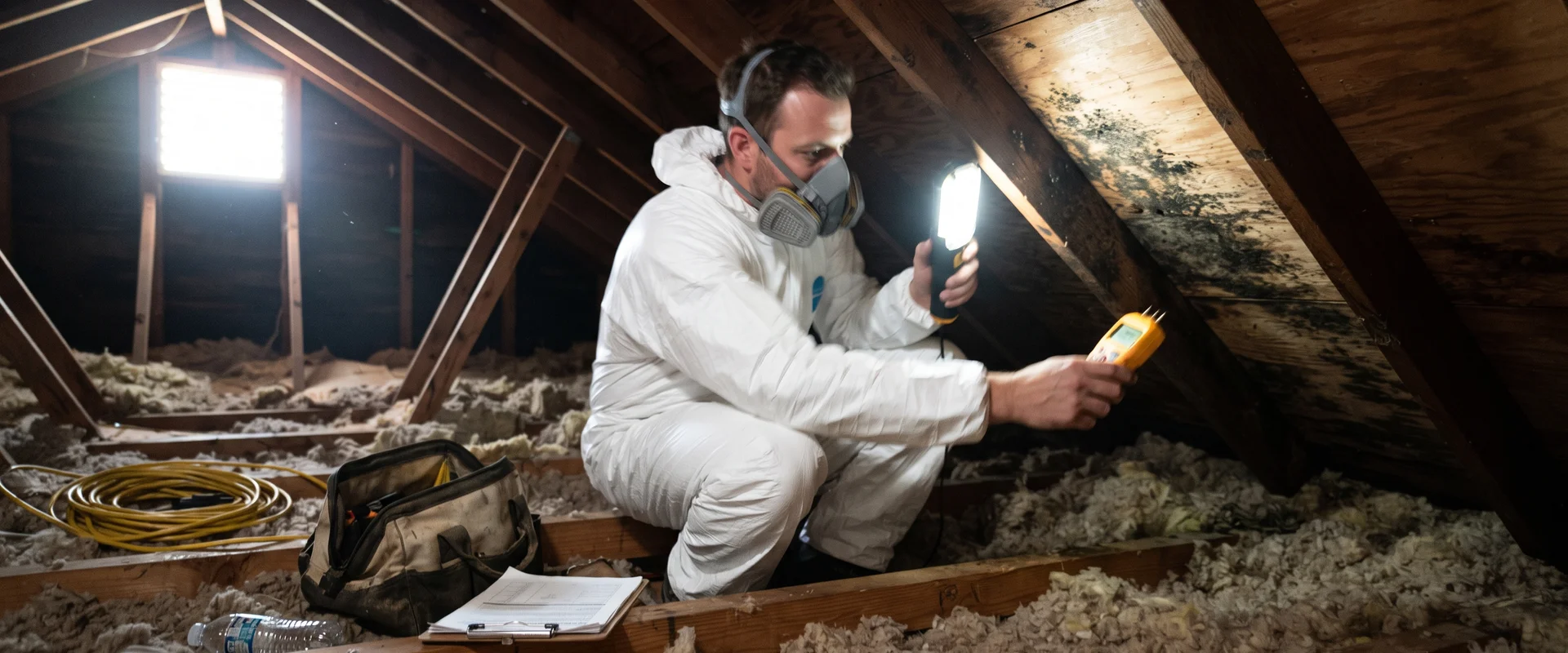
Mould Inspection & Remediation Across Hamilton
Inspection, air-quality testing, containment, and IICRC S520 remediation from attic mould to structural decontamination, with HEPA vacuuming, antimicrobial sealing, and clearance testing.
- ABRA & IICRC certified
- 1-2 hour emergency response
- Unmarked, discreet vehicles
- Direct insurance billing
Project-based pricing with a free on-site estimate. We bill your insurer directly where the loss is covered.
Clearing out an estate or managing a family property is already a deeply emotional and stressful task. We know that finding hidden water damage during this process feels completely overwhelming.
The sudden discovery of a fungal issue requires immediate attention to protect your health. It is perfectly normal to feel unsure about what to do next.
Our approach to mould inspection and remediation focuses on making your property safe again. Grab a cup of coffee, and let’s go through the steps together.
What Mould Remediation Involves
Mould is never the actual problem. It is the visible result of a hidden moisture problem. We base our entire approach on finding and fixing that water source first.
Health Canada reports that spores can begin colonising organic materials within 24 to 48 hours when indoor relative humidity rises above 55 percent. Any cleanup effort that ignores the underlying leak is just a temporary cosmetic fix.
The IICRC S520 Standard in Action
Our crews inspect the property, measure the moisture levels, and remediate to the strict IICRC S520 standard. This documented procedural standard ensures the physical removal of contamination instead of just spraying chemicals.
Remediation itself is essentially a massive containment exercise. We build a thick 6-mil poly containment barrier around the work zone before touching anything. Disturbing established growth in a hoarded room releases enormous numbers of harmful spores into the air.
This sealed area runs under constant negative air pressure. Our negative air machines pull airborne spores directly into HEPA filters instead of letting them travel through the HVAC system to the rest of the house.
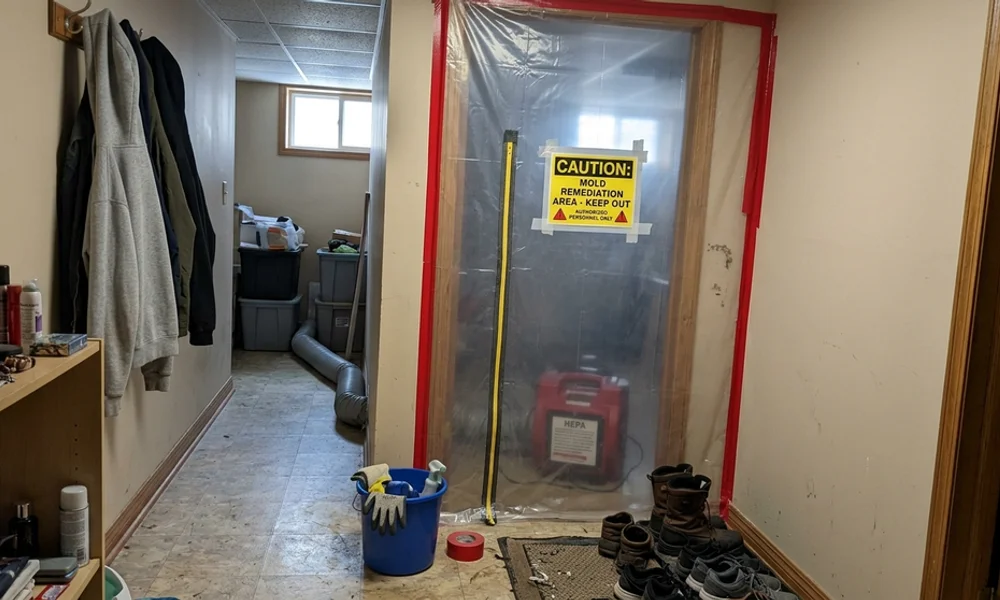
Inside the containment zone, all affected porous materials must come out. Items like saturated insulation, soiled carpet underlay, and drywall with colonised paper facing cannot be reliably cleaned. We remove these items because you simply cannot decontaminate the interior of a porous material.
Semi-porous and non-porous surfaces such as framing, concrete, and structural sheathing undergo a different process. Technicians HEPA-vacuum these solid surfaces, treat them with antimicrobials, and apply sealants where appropriate. Our team then verifies the cleanliness of the space to ensure it is completely safe for your family.
Inspection and Testing
We hold the ACAC Certified Residential Indoor Environmentalist credential, allowing us to accurately assess and remove hazards. This dual expertise means you get honest advice about when expensive laboratory analysis is actually necessary. A standard professional assessment in Ontario typically costs between $300 and $700. Our goal is to save you from paying for unnecessary tests when the source of the problem is already obvious.
Testing truly earns its place when growth is suspected but hidden behind walls. Occupants experiencing respiratory symptoms often need to know the exact species and concentration they are dealing with. We also recommend testing during disputes with landlords or as post-remediation clearance to prove the home is clean.
Spore trap sampling using Air-O-Cell cassettes provides hard numbers instead of just opinions. Laboratories analyse these indoor samples against an outdoor control sample to find hidden spikes in airborne particulates. We usually suggest skipping the pre-test if you have clearly visible black growth from an obvious roof leak. Putting that testing budget directly toward the actual cleanup makes much more financial sense.
Common Problems We Solve
Attic Mould From Ventilation, Not Leaks
The most common attic call in the Hamilton and Greater Toronto Area has nothing to do with roof damage. We constantly find bathroom vents dumping moist air directly into the attic rather than outside. Warm, humid indoor air frequently escapes through ceiling penetrations. This moisture quickly condenses on cold wooden sheathing during Canadian winters.
We warn clients that treating the stained sheathing without correcting the airflow simply resets the clock. The resulting fungal colonies across the dark north slope will just return. Fixing the ventilation and upgrading to current Ontario building code standards stops the cycle completely.
Chronic Basement Humidity
Our crews know that older housing in Dundas, Ancaster, and the lower city sits on porous stone or block foundations. These aging structures usually have little or no sub-slab drainage to keep groundwater away. The naturally high summer humidity in the local valley makes this dampness much worse. We frequently see permanently elevated moisture loads in finished basements built decades after the original construction.
Health Canada recommends maintaining indoor relative humidity between 30 and 50 percent to prevent biological growth. You will need to know exactly which factor requires attention to keep the space dry. We carefully remediate the active growth before investigating the specific cause of the dampness. The permanent solution might involve fixing exterior grading or running a high-capacity commercial dehumidifier. Proper sub-floor drainage is also highly effective. Our technicians identify the exact failing system so your basement stays healthy year-round.
Hidden Mould After a Water Loss
Water from a burst pipe that was extracted but never properly dried creates a perfect breeding ground. Large colonies begin growing out of sight inside wall cavities and under expensive hardwood flooring. We often get calls from homeowners who notice a terrible musty smell months later, even though there is no visible spotting anywhere.
Non-invasive tools like FLIR thermal imaging cameras easily spot cold, damp pockets hiding behind drywall. Tramex moisture meters confirm the exact moisture content of the building materials without causing unnecessary damage. We then perform targeted openings in the drywall to confirm the exact location of the hidden hazard. Hidden colonies frequently thrive in these specific unseen areas:
- Behind baseboards on cold exterior walls
- Underneath warped hardwood or laminate flooring
- Inside damp HVAC return ductwork
- Behind aging bathroom vanity cabinets
Finding these hidden pockets early prevents the need for massive demolition later.
Remediation Done Without Containment
We are unfortunately often the second company hired for a property cleanup. A well-meaning family member or a cheap contractor previously removed stained drywall without any containment. Tearing out contaminated materials without negative air machines sends millions of microscopic spores flying everywhere. We now have to treat a vastly elevated spore count that has settled throughout the entire property.
Proper plastic containment is never an optional line item on an invoice. A secure barrier is the only difference between safely cleaning one small room and permanently contaminating a whole house.
Health, Insurance, and What It Costs
Our team understands that biological exposure affects every person differently. Children, seniors, and occupants with asthma react strongly at spore concentrations that others might completely tolerate. A worsening of asthma control is a major red flag for indoor air quality problems. We urge clients to watch for common physical symptoms like these:
- Persistent nasal congestion
- Unexplained coughing or wheezing
- Chronic eye and throat irritation
If these health symptoms improve significantly when occupants leave the house, you must take that pattern seriously. Homeowners insurance coverage in Canada relies entirely on the specific cause of the moisture. We know that paying for this unexpected cleanup is a huge worry for families. Fungal growth following a sudden, accidentally covered water loss like a frozen burst pipe is frequently claimable.
Before committing to remediation, our comparison of mould inspection versus remediation explains which one your situation actually calls for. Standard remediation costs across Canada can range from $2,500 for a minor bathroom issue to over $20,000 for a severe whole-house contamination. We always advise families that damage from long-term humidity, slow seepage, or deferred maintenance is almost always excluded by insurers. Understanding how adjusters view water damage helps you prepare for the claims process. The chart below explains common coverage scenarios.
| Water Source | Insurance Status | Typical Reason |
|---|---|---|
| Burst frozen pipe | Usually Covered | Sudden and accidental event |
| Sudden appliance failure | Usually Covered | Unforeseeable mechanical break |
| Chronic basement seepage | Usually Excluded | Considered deferred maintenance |
| Poor attic ventilation | Usually Excluded | Gradual buildup over time |
We carefully document the moisture source, the meter readings, and the timeline in every single case. This detailed, professional documentation is exactly what the insurance adjuster needs to approve your claim. Pricing for your specific project is based on the affected square footage, the strict containment requirements, material disposal, and any necessary laboratory testing. Our initial assessment is completely free, and you will get an honest answer if the situation does not require professional intervention.
Dealing with property damage during an estate cleanout takes a heavy toll on your energy. The regulations around mould inspection and remediation can feel completely overwhelming.
We hope this guide gives you a clearer path forward.
You do not have to figure out these difficult air quality issues alone. A safe, healthy home is entirely within reach.
Our team is ready to step in, secure the property, and handle the heavy lifting for you. Reach out today for a free assessment to safely restore your home.
What's Included
- Attic and structural mould removal
- Professional indoor air-quality testing
- Containment, HEPA vacuuming, antimicrobial sealing
- Post-remediation clearance inspection
- Moisture source identification
- IICRC S520 compliant protocols
How Much Does Mould Remediation Cost?
Every job is priced on severity, scope, and disposal, so these are planning ranges rather than quotes. The on-site assessment is free, and where the loss is covered we bill your insurer directly.
Inspection & Testing
Where mould is hidden or the source is unclear
- Visual inspection and moisture mapping
- Spore trap or Air-O-Cell air sampling
- Laboratory analysis and interpretation
- Written findings and recommended scope
Standard Remediation
Contained area, typical residential mould
- 6-mil poly containment and negative air
- Removal of affected porous materials
- HEPA vacuuming and antimicrobial treatment
- Antimicrobial sealing of remaining structure
- Post-remediation clearance verification
Whole-Structure / Attic
Attic, multi-room, or recurring mould
- Everything in the standard scope
- Attic sheathing treatment and insulation replacement
- Ventilation and moisture-source correction advice
- Coordinated rebuild
- Clearance testing with documentation
Mould work is priced on affected area, containment requirements, material removal, and whether testing is needed before or after. Mould following a sudden covered water loss is often claimable; long-term humidity damage usually is not.
Why Choose Us for Mould Remediation
What you get with Hamilton Hoarding Pros that a general cleaning or junk-removal crew cannot provide.
We Fix the Cause, Not the Stain
Mould is a symptom of a moisture problem. Remediating without identifying the water source guarantees you will be looking at it again within a year.
ACAC Certified Environmentalist
Our ACAC Certified Residential Indoor Environmentalist credential covers assessment and air quality, not just removal, so the diagnosis is as qualified as the remediation.
Proper Containment
6-mil poly and negative air pressure keep spores inside the work zone. Remediating without containment distributes the problem through the whole house.
Honest About Testing
Visible mould with an obvious source rarely needs pre-testing. We will tell you when testing adds value and when it just adds cost.
Clearance You Can Show
Post-remediation verification gives you documentation for an insurer, a buyer, or a tenant rather than a verbal assurance.
Water Damage Capable
Because we also do IICRC S500 water restoration, we can address the leak, the drying, and the mould as a single project.
How Our Mould Remediation Works
No surprises. This is the sequence from your first call through to documented clearance.
- 01
Inspect & Measure
Visual inspection, moisture meter readings, and thermal imaging to find both the mould and the water feeding it.
- 02
Test If Needed
Spore trap or Air-O-Cell sampling when growth is hidden, when occupants are symptomatic, or when a baseline is needed for a claim.
- 03
Contain & Remediate
6-mil poly containment under negative pressure, removal of affected porous material, HEPA vacuuming, and antimicrobial treatment.
- 04
Verify & Correct
Clearance testing confirms the result, and we tell you exactly what moisture issue has to be fixed to stop it recurring.
How Hamilton Hoarding Pros Compares
| Feature | Typical Provider | Hamilton Hoarding Pros |
|---|---|---|
| Standard followed | None stated | IICRC S520 remediation protocol |
| Containment | Plastic sheet taped to a doorway | 6-mil poly with negative air pressure |
| Assessment credential | Installer judgement | ACAC Certified Residential Indoor Environmentalist |
| Testing | Not offered or upsold always | Recommended only where it changes the scope |
| Moisture source | Not investigated | Identified and reported with readings |
| Clearance | Visual sign-off | Post-remediation verification with documentation |
Mould Remediation in the Field
Documentary photos from real jobs, shared without identifying details. Click any image to enlarge.
Try Our Free Remediation Project Cost Estimator
Ballpark estimate for a cleanup/restoration project by area, severity, and service type.
Estimate My CostNeed mould remediation handled properly?
One call, a free assessment, and a crew that can legally do the whole job.
What Customers Say About Our Mould Remediation
Every job is confidential. These are real situations our crews handled across Greater Hamilton and Kitchener-Waterloo.
My father passed alone in his apartment and wasn't found for over a week. Dean's team arrived within an hour, handled everything with incredible sensitivity, and dealt directly with our insurance. I never had to set foot in that apartment again.
I manage 40+ rental units across Kitchener-Waterloo. When a tenant left behind a severe hoarding situation with animal waste and needles, Hamilton Hoarding Pros had the unit safe and rent-ready in three days. No other company I called would even take the job.
Our basement flooded with sewage at 2 AM on a Sunday. They answered immediately, arrived by 3:30, and worked through the night. The tobacco smell that had lingered for years was gone after their ozone treatment too. Genuinely saved us from a far worse outcome.
Mould Remediation FAQs
How do I know if I have a mould problem?
Do I need air quality testing before remediation?
Is black mould always dangerous?
How long does mould remediation take?
Will insurance cover mould remediation?
What causes attic mould specifically?
Can you remove mould without tearing out drywall?
What is post-remediation clearance testing?
Why does mould keep coming back in my basement?
Do you handle the repairs afterwards?
Mould Remediation Guides
Plain-language answers to the questions people ask before they call us.
Mould Exposure Symptoms & When to Test Indoor Air Quality
Common mould-exposure symptoms, who is most at risk, spore-trap and Air-O-Cell testing, and when testing should come before remediation.
Musty Smell & Black Mould in the Attic: What It Means
What causes attic mould and musty smells, the health signals to watch, Stachybotrys risks, and when to test your indoor air quality.
Mould Inspection vs Immediate Remediation: Which First?
When to test first, the visible-mould exception, clearance testing after remediation, and how sequencing affects cost.
Related Services
Ready to Book Mould Remediation?
Certified mould inspection & remediation with a free on-site assessment, complete discretion, and direct insurance billing.