As a team specializing in complex estate clearances across Canada, we often see families overwhelmed by the logistical realities of an unattended passing.
The delayed discovery death cleaning process requires more than standard surface washing.
Our approach prioritizes safety, discretion, and structural integrity.
Let’s look at the specific steps involved and what you can expect during this challenging time.
Before We Attend
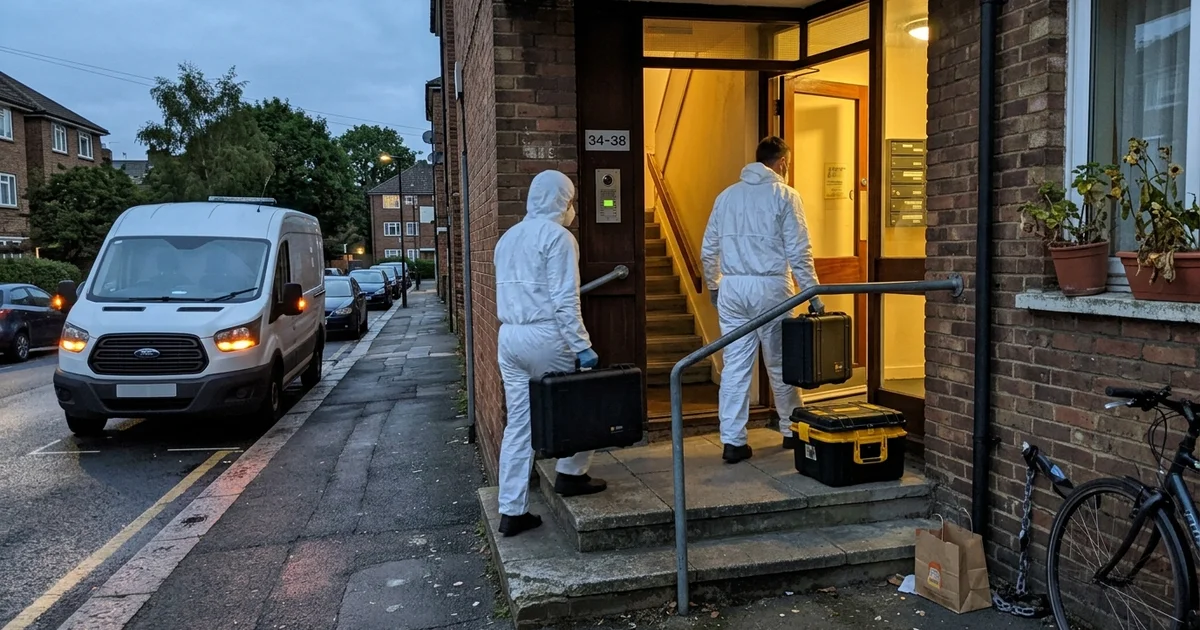
Where local authorities or the provincial coroner have attended, the property remains under official jurisdiction and must be formally released before unattended death remediation can begin.
You can call us before that point, and most families do, because it simply takes the next stressful step off your list. We stage our response immediately so our team is ready to attend the moment the property is cleared.
Canadian provincial laws require strict scene preservation until the coroner finishes their initial assessment. A quick phone call is all it takes to get us on standby.
We need very little from you to get started:
- The exact property address
- The current official release status
- Your preferred access method (key, superintendent, or family member)
You are never expected to describe the scene yourself.
Step One: Assessment of the Delayed Discovery Death Cleaning Process
The first visit maps the problem rather than immediately starting work. A specialized technician identifies how far biological material has migrated and which structural elements are affected.
Fluids can easily travel up to two feet outward within 24 hours on porous surfaces. We use tools like Delmhorst moisture meters to track this unseen moisture within floorboards and drywall.
Odour penetration is another critical factor evaluated during this stage. In a multi-unit building, airborne particulates can quickly reach common corridors or adjoining units through shared HVAC systems.
Photographs document the entire space before a single item is disturbed. We provide you with a written scope detailing the exact remediation plan.
This free, no-obligation assessment outlines our complete set of unattended death cleanup steps. You will see exactly what requires removal and what can be salvaged.
Our documentation includes three key metrics for transparency:
- Migration Depth: Exact measurements of subfloor and joist penetration.
- Material Classification: Clear distinctions between porous and non-porous surfaces.
- Completion Standards: The specific scientific thresholds required for handover.
Step Two: Containment
Barriers first seal the affected area from the rest of the home. A commercial negative air machine, operating at 500 cubic feet per minute, keeps the space at a lower pressure than surrounding rooms.
Clean air constantly flows inward, preventing cross-contamination. We equip these machines with medical-grade HEPA filters to capture microscopic hazards.
The standard containment setup includes:
- Polyethylene physical barrier walls
- High-capacity negative air machines
- Certified HEPA filtration systems
These specific filters are required to trap 99.97 percent of airborne particulates down to 0.3 microns. Nothing that becomes airborne during the work will ever migrate into clean living spaces.
We prioritize this isolation stage to protect everyone in the vicinity. In apartment buildings, this crucial step shields your neighbours from unpleasant odours.
Odour complaints from adjoining units are frequently how these private situations become public knowledge. Containing the environment immediately stops that risk in its tracks.
Our team ensures the discrete nature of the project is maintained from start to finish.
Step Three: Removal in the Decomposition Cleanup Process
Porous materials that have absorbed biological fluid require complete removal rather than surface treatment. No liquid disinfectant can penetrate deeply enough into a porous substrate to guarantee safety.
The decomposition cleanup process dictates that these materials are stripped back to clean structural framing. This typically means removing carpets, contaminated flooring sections, and the lower band of drywall where wicking happens.
Where fluid absorption reaches joist cavities, the removal zone extends accordingly. Everything is securely double-bagged, manifested, and handled strictly by licensed biomedical waste haulers.
Canadian regulations, such as Ontario Regulation 347, govern the legal transport of these specific biohazards on public roads. We strictly follow these provincial mandates to protect your liability.
Contents undergo a rigorous triage procedure during this stage. Items sitting in unaffected areas are carefully set aside for the family.
We prioritize saving vital documents, family photographs, and irreplaceable keepsakes. Directly contaminated soft goods simply cannot be salvaged safely.
| Item Category | Treatment Approach | Typical Outcome |
|---|---|---|
| Carpets & Underlay | Full extraction and disposal | Cannot be salvaged |
| Upholstered Furniture | Biohazard bagging and removal | Cannot be salvaged |
| Hardwood & Subfloor | Cut out past the migration line | Replaced during rebuild |
| Personal Documents | Isolated if outside the affected zone | Returned to family |
| Hard Plastics & Glass | Hospital-grade surface disinfection | Safely retained |
Our technicians will tell you honestly which category a specific item falls into. You always have clear information to make decisions about the estate.
Step Four: Treatment and Sealing
The remaining structural elements are cleaned and disinfected using Health Canada DIN-registered products. Technicians apply these hospital-grade solutions and allow them to sit for their full required contact time.
Standard surface wiping is never enough to neutralize advanced biological pathogens. We ensure every remaining square inch of the exposed framing or concrete is thoroughly treated.
The danger of skipping steps
Applying a sealant over untreated biological material is a critical mistake. The organic compounds will eventually break down the sealant from the inside, causing the odours to return weeks or months later.
Certain substrates, like load-bearing structural concrete, cannot simply be removed. These surfaces receive targeted treatment before being coated with a specialized, shellac-based primer.
A commercial product like B-I-N permanently locks in any microscopic residual compounds. We rely on this two-step methodology to guarantee the environment remains safe for future occupants.
This specific stage is exactly where remediation jobs are won or lost. Sealing an untreated substrate only traps the underlying problem temporarily.
Treating a surface without properly sealing it allows residual off-gassing to continue indefinitely. Both precise actions are mandatory for a permanent resolution.
Step Five: Odour Treatment
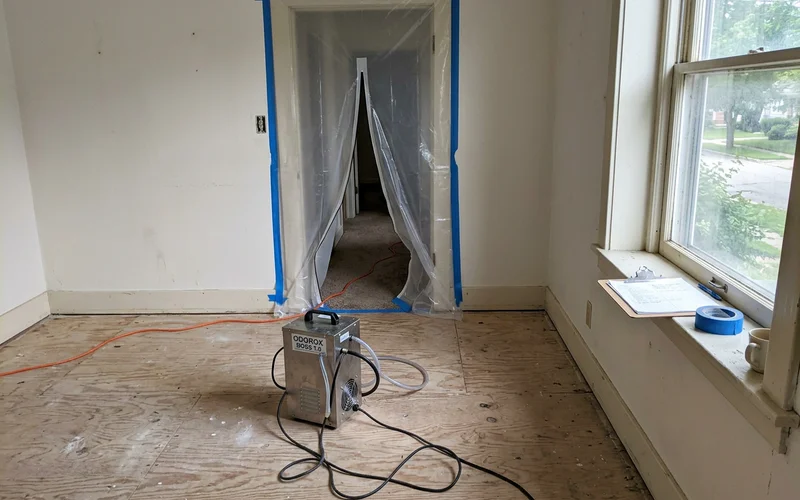
We deploy advanced hydroxyl generators in partially occupied buildings because they are completely safe to use around people. These machines, like the Odorox systems, replicate the natural air-cleansing process of outdoor ultraviolet light.
Every property absorbs volatile organic compounds differently, requiring specific technological approaches:
- Hydroxyl Generators: Safe for occupied spaces and replicate natural UV cleansing.
- Ozone Generators: Used only in vacated properties with mandatory 24-hour airing.
- Chlorine Dioxide: Deployed for the most severe cases of deep structural absorption.
The treatment equipment stays on site until a neutral environment is achieved, rather than for a predetermined schedule. We monitor the air quality daily to ensure the process is actually working.
The equipment might run for a few hours or several days depending on the initial severity.
Why odour is treated last
Running a generator while contaminated material is still in the building is wasted time and money. Source removal first, then sealing, then oxidation. Any company proposing treatment before removal is selling equipment hours rather than a result.
Step Six: Verification and Handover
Scientific ATP bioluminescence readings measure any residual biological material left on the treated surfaces. Hygiena luminometers produce immediate numeric results displayed in Relative Light Units.
A reading under 10 RLU confirms the surface meets stringent hospital-grade sanitation standards. We compile these exact readings into your final completion report.
Your official handover package will always include:
- Numeric ATP bioluminescence readings
- Comprehensive before-and-after photographs
- The original written project scope
- Certified biomedical waste disposal manifests
Having this paperwork proves to future buyers or insurers that the property was professionally remediated. Our comprehensive guide on how the result is verified explains this exact testing method in detail.
You have complete transparency into the final outcome.
The final handover can happen with you directly at the property. A designated lawyer, property manager, or family representative can also accept the handover on your behalf.
We find most families prefer this second option to avoid returning to the scene. It is a completely reasonable decision that protects your emotional well-being.
Timeline for Unattended Death Cleanup Steps
Early-discovery incidents contained to a single room are generally completed within one to two days. A true delayed discovery death cleaning process, involving deep structural absorption, typically runs three to five days.
The total timeframe heavily depends on how many hours the specialized odour equipment needs to operate. We always provide a realistic schedule during the initial assessment rather than an overly optimistic guess.
Several factors dictate the final project duration:
- The amount of time before the initial discovery
- The depth of fluid absorption into structural materials
- The migration of odours into shared HVAC systems
Extended cases involving multi-unit apartment complexes or heavy structural tear-outs will naturally take longer. Advanced biological degradation past the 72-hour mark significantly increases the required labour.
Our primary focus is restoring the property safely, regardless of how long the process takes.
If you are currently facing an overwhelming estate clearance, please reach out for a confidential consultation. Taking that first step gets the hardest part off your shoulders.