Why Verification Exists at All
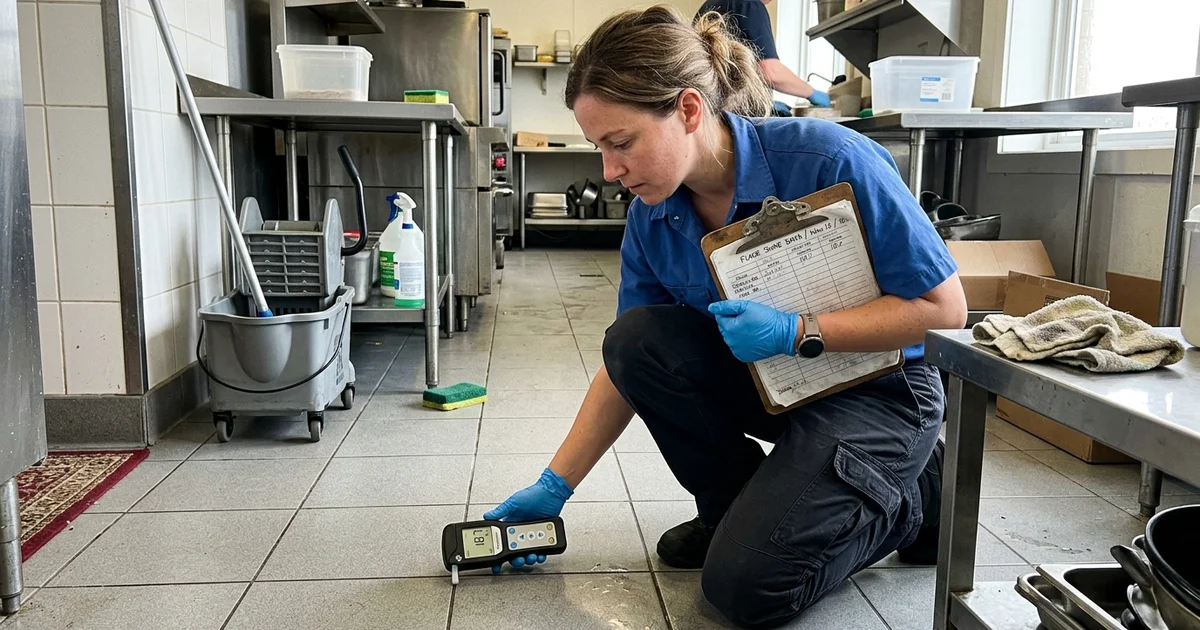
Our team often sees rooms that look completely immaculate, yet still carry significant hidden biological residue. Appearance simply does not equal safety.
We use objective verification methods to bridge this gap and prove a space is truly clean.
For anyone funding the work, this data answers the only question that matters: is this property safe to live in again?
Our documentation provides concrete proof for insurers to confirm the completed scope. Without it, trauma scene remediation becomes a matter of blind faith.
We refuse to rely on faith when dealing with health hazards. Trust is a poor substitute for a scientifically verified number, so we will show you exactly how trauma scene cleanup is verified in the field.
Step One: Containment
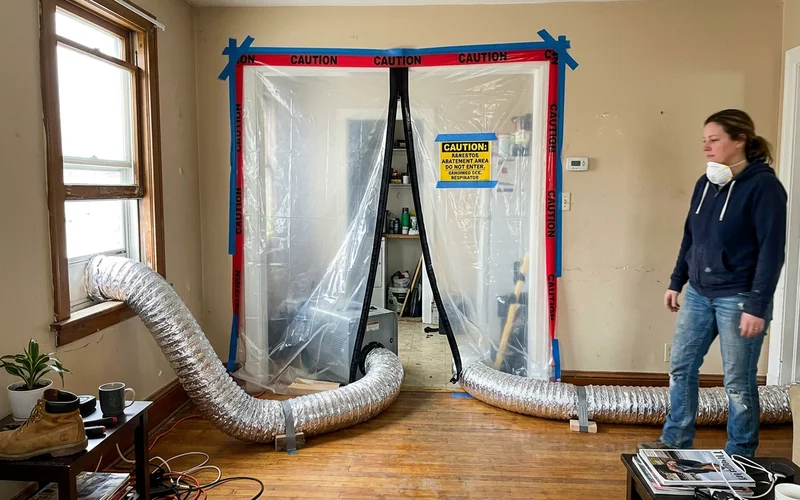
Our technicians never touch a contaminated surface before establishing full containment. A proper setup prevents dangerous airborne particulates from migrating into clean areas of the home.
We rely on three non-negotiable containment rules for every project:
- Physical Barriers: Heavy-duty plastic sheeting completely seals the work area, including vents and doorways.
- HEPA Filtration: Specialized air scrubbers capture 99.97 percent of airborne contaminants down to 0.3 microns.
- Negative Pressure: The system maintains 4 to 6 air changes per hour (ACH) to pull clean air in and stop dirty air from escaping.
Our team considers this exactly the same scientific principle used in professional mould abatement. Without a regulated bio-safety zone, wiping down a surface just pushes microscopic hazards into the surrounding air.
We see amateur cleanups fail constantly because they skip this exact step. Ignoring containment practically guarantees the property will be left in a more hazardous state.
Step Two: Removal Before Treatment
Our first active step inside the containment zone is removing porous materials that have absorbed biological fluids. Items like carpet padding, mattresses, and upholstered furniture act like giant sponges for pathogens.
We adapt our strategy based entirely on the type of material involved.
| Material Type | Examples | Required Action |
|---|---|---|
| Porous | Carpet, drywall, fabric, mattresses | Physical removal and safe disposal |
| Semi-Porous | Wood, concrete, grout | Deep chemical treatment or sealing |
| Non-Porous | Glass, metal, treated plastics | Surface cleaning and disinfection |
Heavy biological fluids can penetrate deep into a subfloor in a matter of hours, rendering standard surface sprays useless. We know that no liquid disinfectant can ever reach the interior core of a thick, porous substrate.
Leaving these saturated materials in place preserves the pathogen load and guarantees severe odours will return. Our aggressive removal phase frequently surprises families who are expecting a basic cleaning service.
This mandatory extraction is the single step that determines whether the remediation is permanent.
Step Three: Disinfection Chemistry
Our cleaning process always targets visible soil loads on non-porous and semi-porous surfaces first. Dirt and organic material create a physical shield that protects dangerous microorganisms from chemical treatments.
We strictly mandate that all surfaces be thoroughly scrubbed before applying any Health Canada approved, DIN-registered product. The specific chemistry selected depends entirely on the environment:
- Broad-Spectrum: Accelerated hydrogen peroxide handles standard bloodborne pathogens efficiently.
- Botanical: Plant-based thymol products like Benefect are ideal around pets, sensitive occupants, and food surfaces.
- Sporicidal: Aggressive chemistry is required because standard disinfectants cannot penetrate the tough exterior shell of spore-forming organisms.
Dwell time is the most-skipped step in the industry
Every chemical label mandates a specific contact time, usually between 5 and 10 minutes, where the surface must stay completely wet. Wiping a product away after thirty seconds creates a false sense of security. Our technicians use physical timers on every job to ensure the solution actually kills the biohazard. This strict adherence to dwell time separates a certified cleanup from a dangerous, superficial wipe-down.
Step Four: ATP Verification
Our verification process relies heavily on testing for Adenosine Triphosphate (ATP). This energy-carrying molecule is present in all living cells, making it the perfect indicator for biological residue.
We execute this test using three rapid steps:
- Swabbing the Zone: A specialized swab collects material from a defined 10-centimetre square area.
- Activating the Reagent: The sample mixes with a chemical reagent, producing bioluminescent light if organic matter is present.
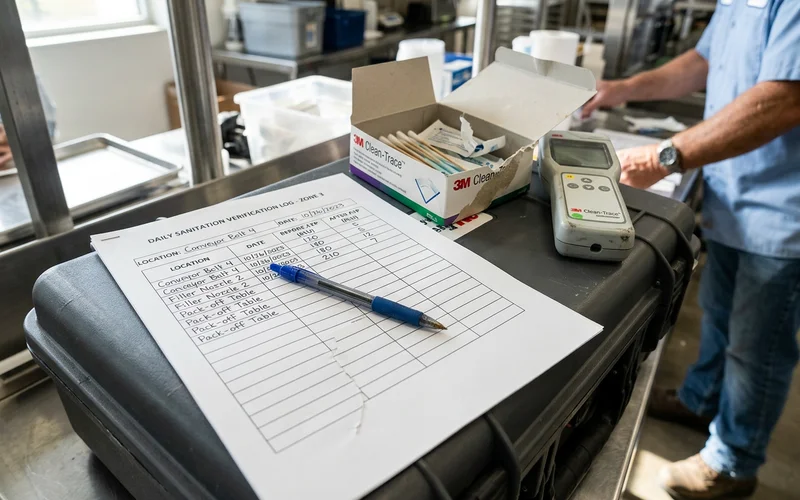
- Reading the Output: A handheld Hygiena luminometer measures the light and delivers a Relative Light Unit (RLU) score in just 15 seconds.
Our target for a passing grade typically falls under 10 to 30 RLU, depending on the surface porosity. High readings demand immediate recleaning, while low readings confirm the decontamination was successful.
We always capture baseline readings before touching a trauma scene to establish the initial contamination level. These before-and-after metrics go directly into the final ATP testing cleanup file.
What ATP Testing Does and Does Not Tell You
Our clients often ask if ATP testing identifies the exact diseases present in a room. The system measures total biological residue, not specific microscopic pathogens.
We use this data to understand the overall cleanliness of a space.
- What It Confirms: Total organic matter removal, cleaning thoroughness, and general surface safety.
- What It Misses: The specific names of viruses, bacteria, or bloodborne pathogens that were present.
Infectious organisms rely on organic matter to travel and survive. We consider a surface showing negligible ATP residue to be an environment that can no longer support a biohazard.
Healthcare facilities and commercial food processors in Canada rely on this exact same testing standard daily. Our post-remediation verification ensures your property meets these rigorous, objective benchmarks.
Studies demonstrate that ATP testing provides immediate, highly sensitive feedback on environmental hygiene.
The Documentation Package
Our final step is delivering a comprehensive documentation package to the property owner or executor. This critical file contains everything required to prove the environment is safe.
We include several key pieces of evidence in every final report:
- Visual Proof: Time-stamped photographs documenting the space before, during, and after the remediation.
- Written Scope: A detailed log outlining every specific item that was physically removed or chemically treated.
- Scientific Data: The complete ATP verification log showing the passing RLU scores for the affected areas.
- Legal Manifests: Official biohazard disposal records confirming the waste was handled legally.
Provincial Ministry of Environment regulations strictly govern how we handle and transport hazardous waste. We use official manifests to prove your biomedical waste went to a licensed destruction facility, like Stericycle, rather than a public landfill. Insurance adjusters routinely demand this exact paperwork to process property claims.
Our clients managing overwhelming estate clearances often value this data even more, because it converts a verbal promise into concrete evidence. The guide we published on what the certifications cover explains exactly where these strict industry standards originate.
We strongly encourage you to demand objective proof before signing any contract with a cleanup provider. Reach out to our experts directly if you need a scientifically verified cleanup, or use these testing standards to carefully vet your local options.