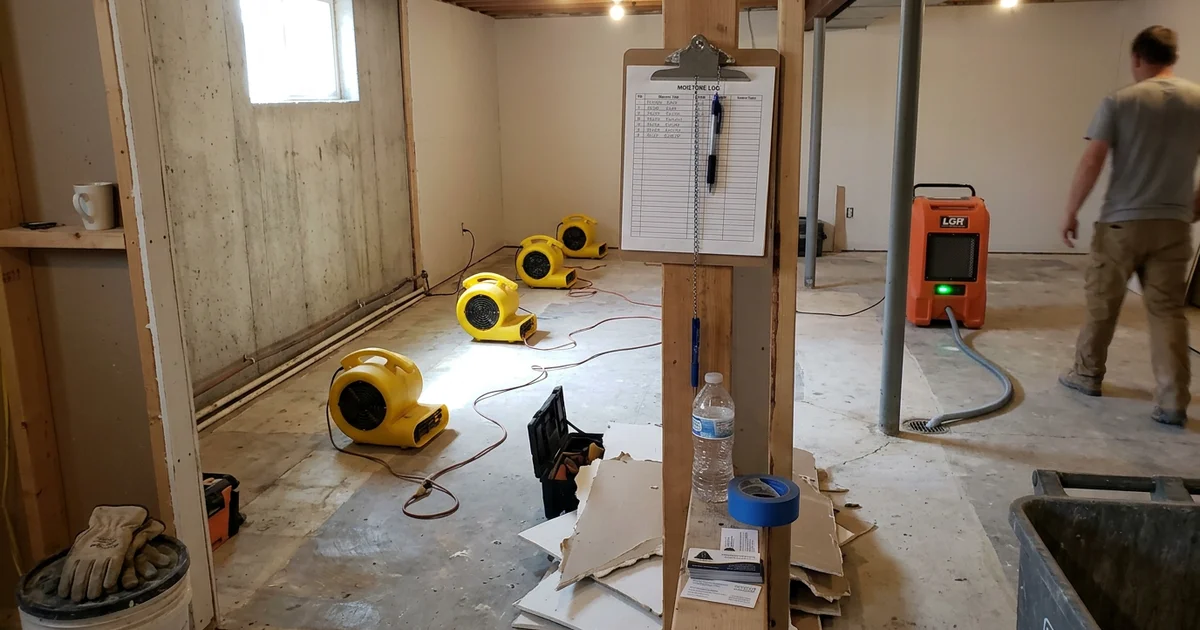
You know how quickly a standard estate clearance turns into a crisis when you move a stack of boxes and find a soaked, rotting floor.
We see this scenario frequently across Canada, where an unnoticed leak behind years of clutter creates a massive hidden hazard. The average cost of a basement flood here is now around $43,000, largely because trapped moisture destroys foundations and framing silently.
A fast, professional water extraction structural drying process is the only way to stop the damage and secure the property’s value.
Let’s look at the exact steps involved, what the equipment actually does, and how to handle these overwhelming discoveries safely.
Extraction: The First Few Hours
Extraction is the immediate physical removal of standing water to stop absorption into the building’s materials. This critical first step dictates the success of the entire recovery effort. Every hour water sits in a cluttered home, it wicks deeper into baseboards and flooring.
Our crews rely on the IICRC S500 standard to determine the exact equipment class required for the contamination level. A standard consumer shop vacuum might pull 10 to 20 gallons per hour, which is useless against a true flood. Professional truck-mounted extractors remove 100 to 200 gallons per hour, halting secondary damage in its tracks.
This speed is exactly why a proper water damage restoration team dispatches with equipment fully loaded. They do not assess first and return later with gear. For carpet over a salvageable substrate, weighted extraction tools compress the fibers to pull water straight from the underlay.
Key Benefits of Rapid Extraction:
- Reduces structural warping: Gets bulk water off wood floors before they buckle.
- Lowers drying times: Every gallon extracted physically is one less gallon to evaporate.
- Prevents immediate mold: The EPA notes mold can colonize within 24 to 48 hours.
Category 3 losses, which involve raw sewage or heavy contamination often found in neglected properties, require simultaneous containment. This ensures dirty water is not tracked through the rest of the house. Our guide to Category 1, 2 and 3 water sets out exactly where a loss falls and what that classification changes.
Moisture Mapping: Finding What You Cannot See
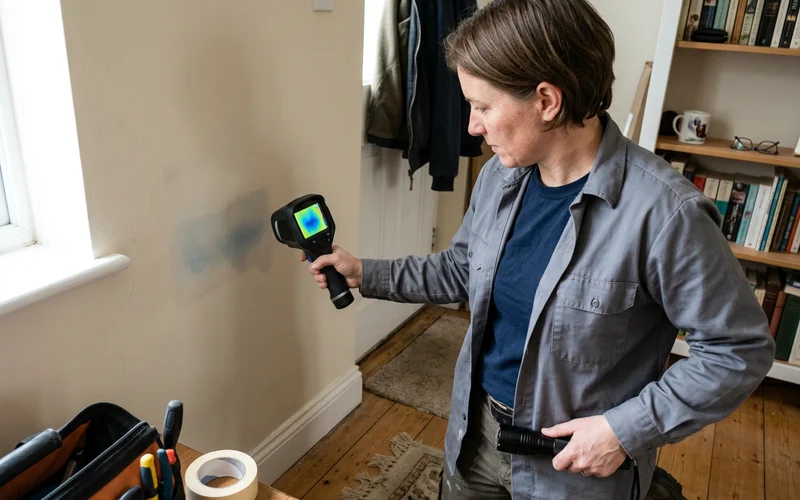
Moisture mapping is the scientific process of locating hidden water pockets behind walls, under floors, and within structural cavities. This step prevents you from accidentally leaving trapped moisture that will rot the house from the inside out. Water travels much further than the visible wet area, wicking up drywall and pooling under floating floors.
We use two specific categories of tools to find these hidden threats. Thermal imaging cameras, like the FLIR C5, show temperature differentials caused by evaporative cooling. Cold spots on the screen reveal exactly where moisture is hiding behind finished surfaces without tearing open the wall.
Moisture meters then confirm the actual water content in those specific materials. The Tramex MRH III is a professional favourite because its non-invasive scanning penetrates up to 25 millimeters into the material. This allows technicians to confirm water under torch-on-felt or thick subfloors without drilling holes.
| Diagnostic Tool | How It Works | Best Used For |
|---|---|---|
| Thermal Camera (FLIR) | Detects evaporative cooling temperature drops. | Scanning large rooms and high ceilings quickly. |
| Non-Invasive Meter (Tramex) | Sends signals up to 25mm deep into materials. | Checking beneath floating floors and membranes. |
| Penetrating Pin Meter | Measures electrical resistance between two pins. | Confirming precise moisture percentages in wood. |
Skipping this diagnostic stage is exactly how properties end up with toxic mold inside a wall that looked perfectly dry. The resulting map dictates the entire drying plan.
Controlled Removal
Controlled removal is the strategic demolition of permanently ruined or contaminated materials to expose the wet structure beneath. It is a targeted extraction of unsalvageable items, not a reckless teardown. Not everything can be saved, especially in heavily cluttered or neglected homes.
Our protocols dictate that any porous materials absorbing Category 3 black water must be discarded immediately. Saturated fiberglass insulation, swollen particle board flooring, and sewage-soaked carpet underlay simply cannot be sanitized.
Common Materials Requiring Removal:
- Saturated Insulation: Loses R-value and traps water against studs.
- Swollen Particle Board: Loses structural integrity permanently.
- Sewage-Soaked Carpet: Harbors dangerous pathogens that cannot be washed out.
When drywall is wet only at the bottom, technicians perform a standard flood cut. This technique involves slicing out the drywall typically two feet above the highest water line or affected area. The flood cut removes the ruined section while preserving the dry upper wall, allowing air to circulate freely into the wet stud cavity.
In many older Canadian homes, technicians must also consider hazardous materials before cutting. Before tearing out 1970s drywall or vinyl tiles, asbestos testing is often required to keep the site safe. Every single piece of removed material is photographed and documented for the executor and the insurance file.
Drying: Evaporation Plus Dehumidification
Structural drying is a calculated two-part system that forces moisture out of materials and then removes it from the air. Both high-velocity evaporation and powerful dehumidification are required to succeed.
Air movers are deployed to direct high-velocity airflow across wet surfaces. This mechanical action strips away the boundary layer of humid air, moving moisture from the physical material into the surrounding room.
Our technicians then use Low-Grain Refrigerant (LGR) dehumidifiers to capture that airborne moisture. LGR units are incredibly efficient, pulling the water vapor out of the air and lowering the room’s overall vapor pressure so evaporation can continue rapidly.
Equipment counts are strictly calculated using mathematics, never guessed. The IICRC S500 standard dictates the exact number of air movers and dehumidification pints required based on the room’s square footage and the specific class of water loss. Proper placement is just as critical, as air movers must be angled to create a vortex of circulation rather than just pointing blindly at a wet patch.
Specialised drying systems
Hardwood floors, wall cavities, and sub-floor spaces are frequently dried using mat systems or injection systems that direct airflow into the assembly rather than across its surface. This is how a hardwood floor gets saved instead of replaced, and it is worth asking about before anyone quotes replacement.
Careful control is necessary because rapidly changing a home’s temperature and humidity can cause secondary damage. If the air gets too hot and dry too quickly, wood trim and antique furniture can shrink or crack.
Daily Monitoring
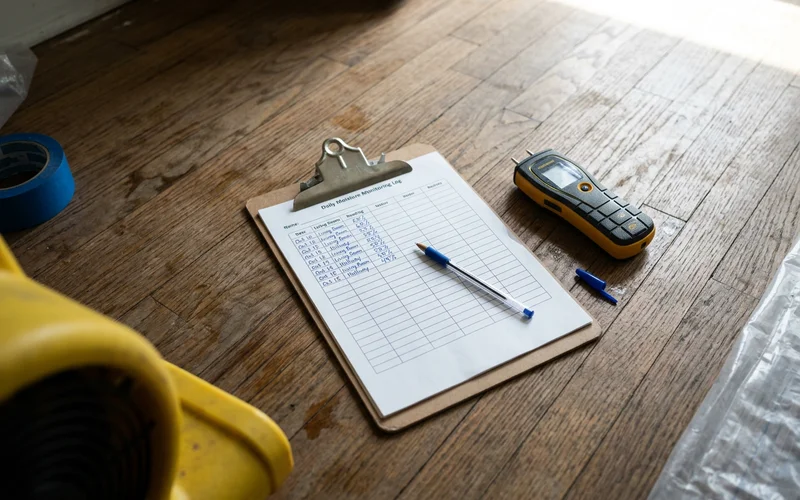
Daily monitoring is the physical inspection and documentation of the property’s moisture levels every 24 hours. This continuous tracking proves the drying plan is actually working and allows for immediate equipment adjustments.
A certified technician attends the site each day to take fresh readings in the exact same locations. They record the ambient temperature, relative humidity, and the specific moisture content of the wet materials.
Standard Daily Log Metrics:
- Ambient Temperature: Ensures the room is warm enough for evaporation.
- Relative Humidity (RH): Confirms the dehumidifiers are managing the air.
- Specific Material Moisture: Tracks the exact percentage of water left in wood and drywall.
- Equipment Amperage: Verifies machines are running efficiently and safely without overloading circuits.
We compare these daily numbers against the natural Equilibrium Moisture Content (EMC) of the home. In Canada, standard wood framing like 2x4 studs must typically drop below 16% moisture content to be considered safe from rot. Drywall requires an even stricter target, often needing to read below 1% on a relative scale.
If the daily readings stall out, the technician will add more dehumidification capacity or reposition the air movers. These logs serve two vital purposes. They guide the physical work on site, and they go directly into the insurance file as undeniable evidence that the structure was completely dried and verified.
Clearance
Clearance is the final, documented verification that all affected materials have returned to their normal, dry state. It is the official finish line that proves the property is safe for rebuilding and occupancy.
The drying process is only complete when the affected areas match the moisture content of unaffected reference materials in the same building. This direct comparison is the true dry standard. A fixed percentage number rarely works universally, because a dry reading in a Hamilton basement during a freezing February looks vastly different from one taken in humid July.
Our team leaves the equipment running until these specific baseline metrics are met. Pulling air movers out a day early just because a surface feels dry to the touch is a massive mistake.
The Danger of “Dry to the Touch”
Surface dryness is an illusion. A drywall panel can feel perfectly dry on the painted side while the paper backing against the studs remains saturated enough to grow mold within 48 hours. Always demand meter-verified clearance.
That premature removal is the single most common cause of toxic mold appearing inside a repaired wall weeks later. Only when the penetrating meters confirm the core of the material is completely dry does the equipment finally come out.
Typical Timeline
A typical structural drying timeline spans three to five days for clean water leaks, but can extend much longer for severe contamination. Knowing this schedule helps families plan their estate cleanup around the disruption. Day one is entirely focused on rapid extraction, debris removal, and equipment setup.
Days two through four involve continuous drying and strict daily monitoring. We generally achieve clearance readings and remove the equipment around day three to five for a standard residential loss.
Timelines vary significantly based on the materials affected.
| Water Damage Scenario | Average Drying Duration |
|---|---|
| Clean water on basic drywall | 2 to 3 days |
| Standard flooded basement | 3 to 5 days |
| Category 3 sewage backup | 7 to 14 days |
| Saturated hardwood floors | 10 to 21 days |
The final restoration phases, including new flooring, fresh drywall, and paint, follow separately once the dry standard is officially met. If you are managing a very small, clean-water leak yourself, our drying equipment rentals come with proper sizing guidance. For anything involving sewage, hidden moisture, or years of hoarded clutter, call a professional for an assessment immediately to protect the property’s value.
Executing a proper water extraction structural drying process is the most effective way to save a property from permanent ruin. Do not let hidden moisture destroy the value of an estate. Contact our rapid response team today to get the specialized equipment and expertise your property needs.