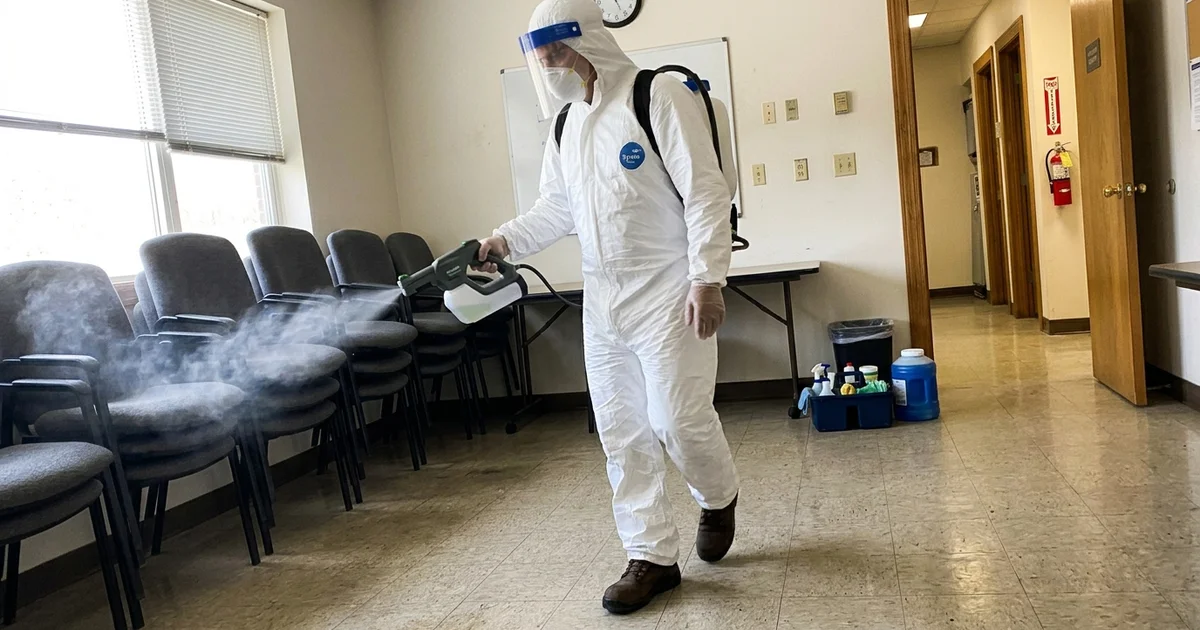
You know how overwhelming an estate clearance or hoarding situation can feel. Behind the visible clutter, families often face invisible threats like persistent bacteria and viruses.
We see this constantly when helping executors manage these emotionally draining properties.
The true challenge isn’t just removing junk. It’s ensuring the home is genuinely safe from pathogens, which is why specialized c diff mrsa covid disinfection services exist.
Our team approaches this by focusing on the science of pathogen removal. A critical part of that process is understanding that standard housekeeping will not neutralize infectious diseases.
You need a targeted strategy backed by proper infection control and decontamination protocols. Let’s look at the data on how long these pathogens survive, what Health Canada requires to kill them, and the exact steps to effectively clear a property.
Cleaning and Disinfection Are Different Steps
Cleaning removes visible dirt, while disinfection chemically destroys microscopic pathogens. You must always perform these as two separate, consecutive actions to make a space safe.
We frequently find families wasting time and money by spraying strong chemicals directly onto dusty or soiled surfaces. The dirt physically blocks the chemical from reaching the bacteria underneath. Organic matter, like the waste often found in hoarding situations, neutralizes the active ingredients in most household sprays.
Our protocol starts with a thorough physical cleaning using detergents to strip away biofilm and soil. This preparation exposes the bare surface. Only then can a Health Canada-approved hard surface disinfectant actually do its job.
Key Differences Between the Two Steps:
- Cleaning: Removes dust, grease, and organic residue using physical friction and soap.
- Disinfection: Inactivates organisms using targeted chemicals with a registered Drug Identification Number (DIN).
- The Sequence: Clean first, then disinfect, never the other way around.
The Three Pathogen Profiles
Different pathogens require entirely different removal strategies based on their biological structure and survival times.
When providing c diff mrsa covid disinfection services, our technicians group these threats into three distinct categories.
SARS-CoV-2 and Enveloped Viruses
SARS-CoV-2 is relatively fragile because its protective lipid envelope is easily broken by standard hospital grade disinfection products. You will typically see survival times on surfaces measured in hours or a few days.
Our approach targets high-touch areas like doorknobs and handrails where transmission is most likely. Health Canada lists numerous common disinfectants that quickly neutralize this virus. The main priority here is thorough coverage rather than extreme chemical strength.
MRSA and ESBL-producing Bacteria
Methicillin-resistant Staphylococcus aureus (MRSA) is an antibiotic-resistant bacterium that can survive on household dust and surfaces for up to five weeks. These organisms create a persistent threat in homes undergoing estate clearance.
We treat MRSA with a high degree of caution because standard cleaning often spreads it around instead of killing it. The Public Health Agency of Canada (PHAC) notes that MRSA easily transmits through skin contact with contaminated items.
Our team prioritizes extreme thoroughness and frequency when wiping down a property exposed to MRSA. Using a broad-spectrum disinfectant with a verified Drug Identification Number is essential for these resilient bacteria.
Clostridioides difficile (C. diff)
Clostridioides difficile is highly dangerous because it forms microscopic spores that survive on dry surfaces for months. Eliminating these spores requires specific sporicidal chemistry, usually chlorine-based, applied at the right concentration.
We see C. diff frequently in properties where the previous occupant experienced prolonged illness or hospital stays.
Common C. diff protocol failures include:
- Using alcohol-based hand sanitizers (ineffective against spores)
- Applying general quaternary ammonium disinfectants
- Failing to physically scrub the surface first
In 2022, the Public Health Agency of Canada reported 1.41 C. diff infections per 1,000 hospital admissions, highlighting its prevalence. Eradicating it from a home requires aggressive mechanical cleaning followed by a verified sporicidal treatment.
Dwell Time: The Step Everyone Skips
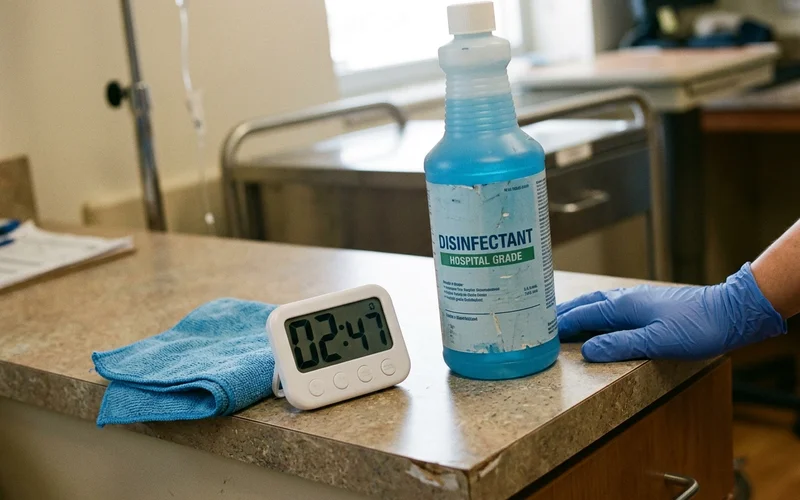
Dwell time is the exact number of minutes a disinfectant must remain visibly wet on a surface to kill a specific pathogen. If the product dries before this time is up, the disinfection process fails.
We constantly see well-meaning executors spray a counter and wipe it dry seconds later. This common mistake leaves a surface that looks clean but remains highly contaminated. Every Health Canada registered product lists its required contact time right on the label.
Our technicians literally use timers for this step. For a tough spore like C. diff, a bleach-based sporicide might need to sit wet for three to five minutes.
Common Dwell Time Mistakes to Avoid:
- Wiping too soon: Removing the chemical before it breaches the pathogen’s cell wall.
- Ignoring the label: Assuming all sprays work instantly on contact.
- Failing to reapply: Letting the surface dry out in warm or well-ventilated rooms before the timer finishes.
Application Methods
The method used to apply a disinfectant determines whether it reaches all contaminated areas and penetrates protective biofilms. Mechanical wiping, electrostatic spraying, and fogging each serve distinct purposes in a cleanup strategy.
We select the application technique based on the specific layout and condition of the property.
Manual Wiping
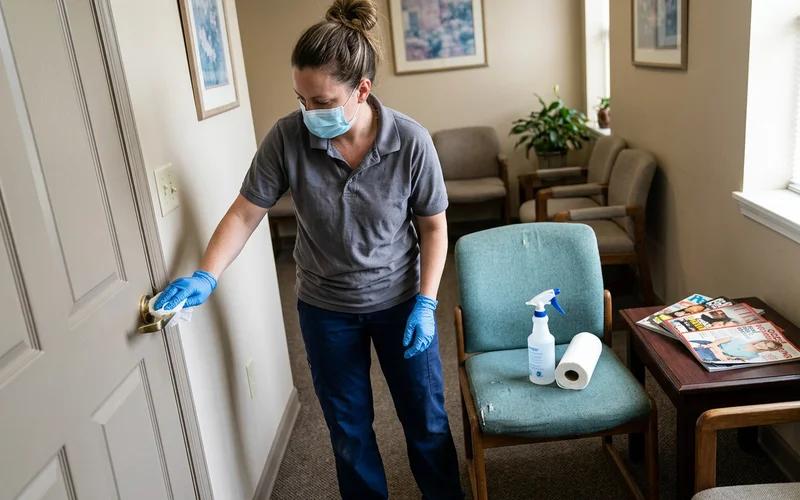
Manual wiping remains the most reliable method for high-touch surfaces. The physical friction of a microfiber cloth removes lingering soil while simultaneously depositing the chemical.
Our staff relies on wiping for common transmission points. This mechanical action is necessary to break down protective barriers that bacteria build.
Electrostatic Spraying
Electrostatic spraying applies a positive electrical charge to disinfectant droplets, causing them to wrap around and cling to irregular surfaces. This tool provides excellent coverage for hard-to-reach areas in heavily cluttered homes.
We use these sprayers as a powerful complement to manual wiping. The charged particles ensure the chemical coats the undersides of tables and the backs of chairs evenly.
Fogging
Fogging distributes a chemical mist throughout an entire room to treat large airspaces and soft furnishings. This method is highly effective for reaching areas that cannot be wiped down manually.
Our crews deploy foggers primarily for final-stage decontamination in extreme hoarding situations.
Fogging is most effective for:
- Porous materials like curtains and carpets
- High ceilings and exposed ductwork
- Rooms with densely packed, irregular contents
It is strictly a secondary measure, as fogging does absolutely nothing to remove physical dirt or soil.
Where high-touch surfaces actually are
Door handles, light switches, handrails, elevator buttons, shared keyboards and phones, chair arms, tap handles, and washroom fixtures. In healthcare settings, bed rails, call buttons, and equipment controls. These surfaces deserve disproportionate attention relative to floors and walls.
Verification
ATP bioluminescence testing provides a concrete, numeric measurement of organic matter left on a surface within seconds. This rapid feedback proves whether the cleaning and disinfection steps actually worked.
We utilize ATP meters to eliminate the guesswork from property decontamination. The device measures adenosine triphosphate (ATP), a molecule found in all living cells, including bacteria and human waste. A high score indicates a dangerous level of contamination remains.
| ATP Score (RLU) | Meaning | Required Action |
|---|---|---|
| 0 to 10 | Hospital-grade clean | None. The surface is safe. |
| 11 to 50 | Acceptable for general areas | Monitor. Safe for low-touch zones. |
| 51 to 200 | Cleaned, but not disinfected | Re-apply disinfectant and observe dwell time. |
| Over 200 | Highly contaminated (Fail) | Complete reclean and disinfect required. |
Our teams log these Relative Light Unit (RLU) readings into a permanent project file. This documentation is invaluable for executors needing to prove the home is safe for contractors, realtors, or new tenants.
Since pathogens travel in organic material, consistently low RLU scores confirm an effectively decontaminated space. This level of proof is the gold standard for commercial viral cleaning and residential decontamination alike.
Who This Is For
This highly structured approach is essential for anyone clearing out contaminated estates, managing extreme hoarding situations, or handling properties post-illness. Families facing these overwhelming tasks need certainty that the environment is safe.
We step in when the risk of infection makes a standard junk removal service inadequate. The guide on decontamination for immunocompromised patients covers the residential side in detail for families bringing a sick relative home. Families consistently rely on comprehensive c diff mrsa covid disinfection services to restore safety to these spaces.
A scheduled, documented program provides the necessary legal and health assurances. You need that paper trail when insurance companies, property managers, or health authorities ask for your specific infection control protocol.
Reach out today to discuss a targeted, professional decontamination plan for your property.